Pedestrian Right of Way in Florida: Who Is at Fault?



By Howard Merricks, Esq., Founding Senior Partner, Merricks Law Group · November 23, 2026
In Florida, drivers must stop or yield to pedestrians in a crosswalk, while pedestrians crossing outside a crosswalk must yield to vehicles. Who had the right of way is often the starting point for deciding fault in a pedestrian accident, but it is rarely the whole story, because every driver also has a duty to use care to avoid hitting anyone on foot. With earlier sunsets after the November time change and snowbird traffic building, these rules matter more than ever in Tampa Bay. Here is how they work and what they mean for your claim.
Why pedestrian accidents are a serious problem in Tampa Bay
Tampa Bay is one of the most dangerous places in the country to walk. In Smart Growth America’s Dangerous by Design 2026 report, the Tampa-St. Petersburg-Clearwater metro ranked 8th in the nation, with 618 people killed while walking from 2020 to 2024. Wide, fast roads like US-19, Dale Mabry Highway, and Fowler Avenue, where signaled crossings can be far apart, are part of daily life here.
When drivers must stop or yield
Florida’s pedestrian traffic law sets out three main situations:
- At a traffic signal: A driver must stop before the crosswalk and stay stopped while a pedestrian with a walk signal crosses on the driver’s half of the road, or is close enough from the other half to be in danger.
- At a crosswalk with signs requiring drivers to stop: The same stop-and-stay-stopped rule applies.
- At a crosswalk with no working signal or sign: The driver must yield, slowing or stopping if needed, to a pedestrian in the crosswalk on the driver’s half of the road or approaching closely from the other half.
One more rule catches many drivers off guard: when a car is stopped at a crosswalk to let someone cross, drivers coming up behind it may not pass it. Many serious crashes happen when a second car swings around a stopped one in the next lane.
When pedestrians must yield
The same law places duties on people walking:
- Do not suddenly step off a curb into the path of a car so close the driver cannot yield.
- Outside a marked crosswalk, or an unmarked one at an intersection, yield to vehicles.
- Between two signaled intersections, cross only in a marked crosswalk.
- Use the sidewalk when there is one. Where there is none, walk on the left shoulder, facing traffic, when practical.

Drivers always have a duty of care
Having the right of way does not give a driver permission to hit someone. Florida’s pedestrian law also says every driver must use due care to avoid colliding with a pedestrian, give a warning when needed, and take extra care around children and anyone who seems confused or impaired. A driver who was speeding, texting, or not watching the road can share fault even when the pedestrian was outside a crosswalk.
Common causes of pedestrian accidents
- Failing to yield at marked and unmarked crosswalks
- Right turns on red without checking the crosswalk
- Distracted driving, including texting while driving
- Speeding on wide, multi-lane roads
- Poor lighting at night and at dusk
- Drunk driving
- Backing up in parking lots and driveways
- Hit-and-run drivers who leave the scene
What if you were jaywalking?
You may still have a claim. Under Florida’s modified comparative negligence rule, your recovery is reduced by your share of fault, and you are barred only if you are found more than 50% at fault for your own harm. For example, if a jury finds your damages are $200,000 and decides you were 25% at fault for crossing midblock, while the speeding driver was 75% at fault, you could recover $150,000.
How PIP works when you are hit on foot
You do not have to be in a car to use Florida’s no-fault coverage. Florida’s PIP law (section 627.736) can cover people struck by a motor vehicle while they are not riding in one. Which policy pays depends on whether you or a relative in your household have your own PIP coverage, along with residency rules. In a hit-and-run, your own uninsured motorist coverage, if you have it, may also help.
What compensation may be available
Depending on the facts, a pedestrian accident claim may include:
- Medical bills, past and future
- Lost wages and lost earning ability
- Pain and suffering and emotional distress, which in Florida motor vehicle cases generally require an injury that meets the state’s serious injury threshold
- Wrongful death damages for families who lost a loved one
Evidence that proves who had the right of way
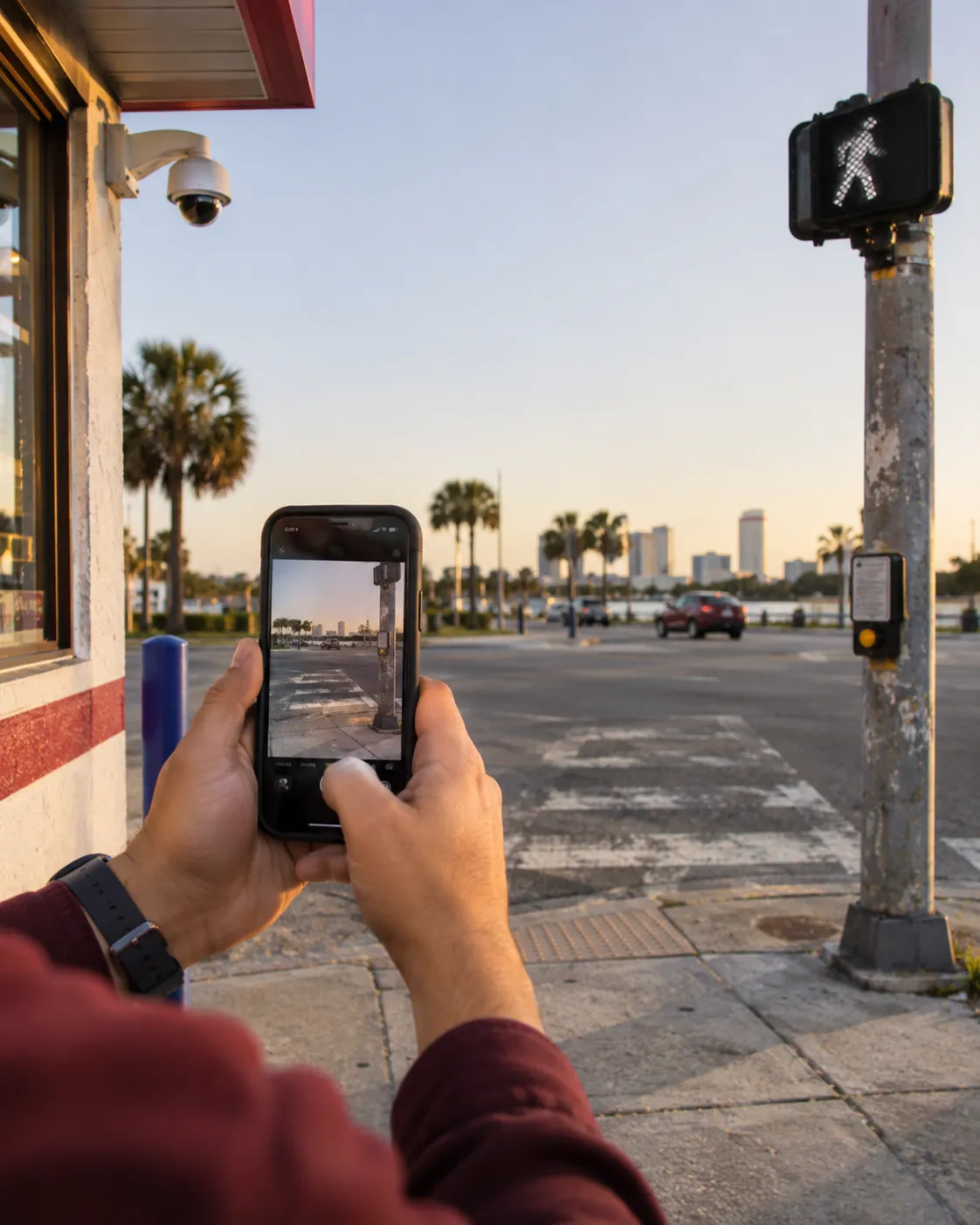
Right-of-way disputes come down to proof. Helpful evidence includes traffic and business camera footage, signal timing records, the crash report, witness names, photos of the crosswalk markings and signs, and the vehicle’s speed data. Camera footage is often recorded over within days, so it should be requested quickly.
What a pedestrian accident attorney does for you
- Requests camera footage and signal records before they are lost.
- Reconstructs the crash to show where you were and how fast the driver was going.
- Identifies every insurance policy, including PIP, the driver’s liability coverage, and uninsured motorist coverage.
- Handles the insurance company, which often tries to blame the person on foot.
- Files a lawsuit if needed, before Florida’s two-year statute of limitations for most negligence claims runs out.
What to do next after a pedestrian accident
- Call 911 and get medical care right away. Under Florida’s PIP rules, initial treatment generally needs to happen within 14 days.
- If you can, note the exact location, the signal and crosswalk markings, and any nearby cameras.
- Get the driver’s name, insurance, and plate number, plus names and numbers of witnesses.
- Do not tell the driver or the insurer that the crash was your fault, even to be polite.
- Talk to a pedestrian accident attorney quickly, before camera footage is erased.
For a full checklist, read what to do after a pedestrian accident.
Talk to a Tampa pedestrian accident attorney
After a pedestrian crash, insurers often try to blame the person on foot. Merricks Law Group pushes back, gathering the footage and records that show what really happened, while treating you like a person, not a case number. Our attorneys bring over 150 years of combined experience. Your consultation is free, and there are no fees or costs unless we win. Call (813) 226-3800, visit our pedestrian accident practice page, or contact us online. Click or Call, That’s All!® Take Back Control of Your Life.®
FAQ
Do cars have to stop for pedestrians in a crosswalk in Florida? Yes. At signals and signed crosswalks, drivers must stop and stay stopped for a pedestrian on their half of the road. At crosswalks without a working signal, drivers must yield.
Who is at fault if a pedestrian is hit outside a crosswalk in Florida? It depends. The pedestrian had to yield, but the driver still had a duty of care. Fault is often shared and split by percentage.
Can I recover if I was jaywalking when I was hit? You may be able to, as long as you are not found more than 50% at fault. Your recovery is reduced by your share of fault.
Does Florida PIP cover pedestrians? It can. Florida PIP can cover people struck by a motor vehicle while not in one, depending on whose coverage applies and residency rules.
What if the driver who hit me drove away? Report it to police right away. Your own PIP and, if you have it, uninsured motorist coverage may help pay for your losses while police look for the driver.
Disclaimer: This article is general information, not legal advice, and reading it does not create an attorney-client relationship. Every case is different. Contact an attorney about your specific situation.
Relatable Articles
Who Can File a Wrongful Death Claim in Florida? 2026 Guide

Who Is Liable in a Florida Truck Accident? Tampa Bay Guide
How to Choose a Car Accident Lawyer in Tampa Bay: A Checklist You Can Actually Use